Trailing drawdown: the number one trap in funded accounts
Published · updated · 16 min read
By Tom · Trader & founder of OrderFlowFutures
Trailing drawdown does not punish your bad trades, it bills the good ones. The exact arithmetic, why order flow is the most exposed, and seven rules to avoid losing a winning account.
There is a way to lose a funded account without ever losing money. Not a figure of speech: an arithmetic fact, which most traders discover on the day their account closes while their balance is still up.
That arithmetic is called trailing drawdown. And if you trade order flow, it targets you more specifically than anyone else: for a precise reason nobody explains.
Trailing drawdown is a loss floor that rises with your gains and never comes back down. In its intraday form it recalculates off your peak unrealized balance: every tick of open profit permanently raises the level at which your account closes. The consequence for order flow: the early entry, which is exactly what the method is for, manufactures favourable excursion you never monetise, and that you pay for in survival room.
---
1. The arithmetic that costs an account without losing a dollar
Take a $50,000 account with a $2,500 trailing threshold. Your starting floor sits at $47,500. You therefore have $2,500 of survival room.
You spot absorption at a level: aggressive market flow hitting a resting limit that refuses to move, with refills at the same price. Clean read. You enter 2 NQ contracts.
Price moves 25 points in your favour. At $20 per point across 2 contracts, that is $1,000 of open profit. Your peak balance goes to $51,000.
Your floor has just moved to $48,500. Immediately, without you closing anything.
Then the read invalidates: refills stop, delta flips, the wall pulls. You do what a good order flow trader is supposed to do: you exit without waiting for the stop. You exit at +4 points, i.e. $160.
Let's count:
- Balance: $50,160. You made $160.
- Floor: $48,500. It will not come back down.
- Remaining room: $1,660, versus $2,500 at the start.
You made $160 and consumed $840 of your account's lifespan. Every dollar banked cost you a little over five dollars of room. Repeat that sequence four times, four correct reads, four disciplined exits, four winning trades, and your account is dead with a balance that went up.
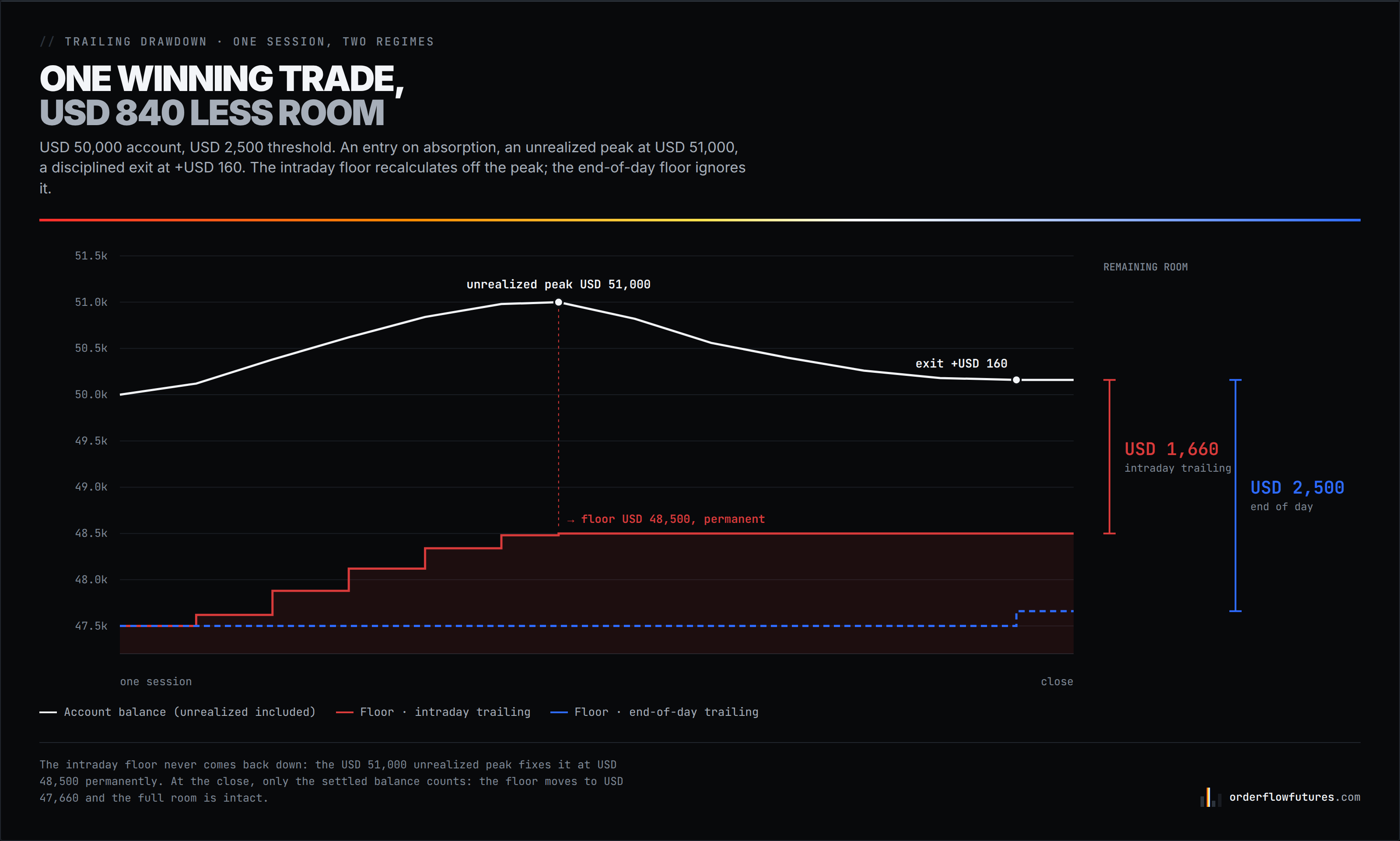
The same session under both regimes: the intraday floor steps up on the unrealized peak, the end-of-day floor ignores it.
That is why it is the number one trap. This is not a rule that punishes bad trades. It is a rule that bills the good ones.
The same trade under an end-of-day drawdown
Run the identical session. Same read, same entry, same exit at +4 points. But the account is on EOD drawdown.
That $51,000 unrealized peak? It does not exist for the calculation. Only the closing balance counts: $50,160. Your new floor is $50,160 − $2,500 = $47,660.
- Remaining room: $2,500. All of it.
- And you kept the $160.
Same skill, same execution, same day. $1,660 of room on one side, $2,500 on the other. The difference has nothing to do with your trading. It comes from a box ticked on the spec sheet of the account you bought.
---
2. The three drawdown families, precisely
The industry's vocabulary is loose, and that confusion is expensive. Three mechanics, three behaviours.
Intraday trailing
The floor tracks your peak unrealized balance, tick by tick. Apex's own documentation is explicit: "The Peak Balance includes both realized and unrealized gains. If an open trade pushes your account to a new high, the Trailing Threshold adjusts upward immediately even if the position is not closed." And it never moves back down.
A crucial point, almost always overlooked: the trailing stops at some level. At Apex, on performance accounts, it locks once the floor reaches starting balance + $100. On a $50,000 account with a $2,500 threshold, that means trailing ceases once your peak clears $52,600, and the floor then stays frozen at $50,100.
Operational translation: the danger zone is finite, and its length is known. The first ~$2,600 of profit is the tunnel. After that, you breathe. That single fact should dictate your tactics, more on this below.
Watch the variants: still at Apex, Rithmic/Wealthcharts evaluations lock at the profit target + $2,000, and Tradovate evaluations never lock at all. The same word, "trailing," covers three different regimes inside a single firm.
End-of-day (EOD) trailing
The floor recalculates once a day, from the closing balance. What your account was worth mid-session does not enter the calculation.
It is objectively more forgiving, and for an order flow trader that is decisive: you can let a position breathe, watch it go to +40 points and come back to +5, without leaving a permanent mark.
But it is not free, and this is where most guides go soft: a winning day raises your floor permanently at settlement. A Monday at +$2,000 followed by a Tuesday at −$2,000 does not return you to the start: your balance came back, your floor stayed $2,000 higher. EOD does not remove the mechanism: it only triggers it on realized results.
Static drawdown
The floor never moves. Full stop.
It is the only regime in which the order flow edge expresses itself completely, because nothing you do intraday degrades your room until you actually realise a loss.
The trade-off sits elsewhere: static accounts generally come with a smaller room. A $500 static floor sounds wonderful, it never moves! : until you work out that $500 on the NQ is 25 points on a single contract. There is no free lunch; there are constraints you choose.
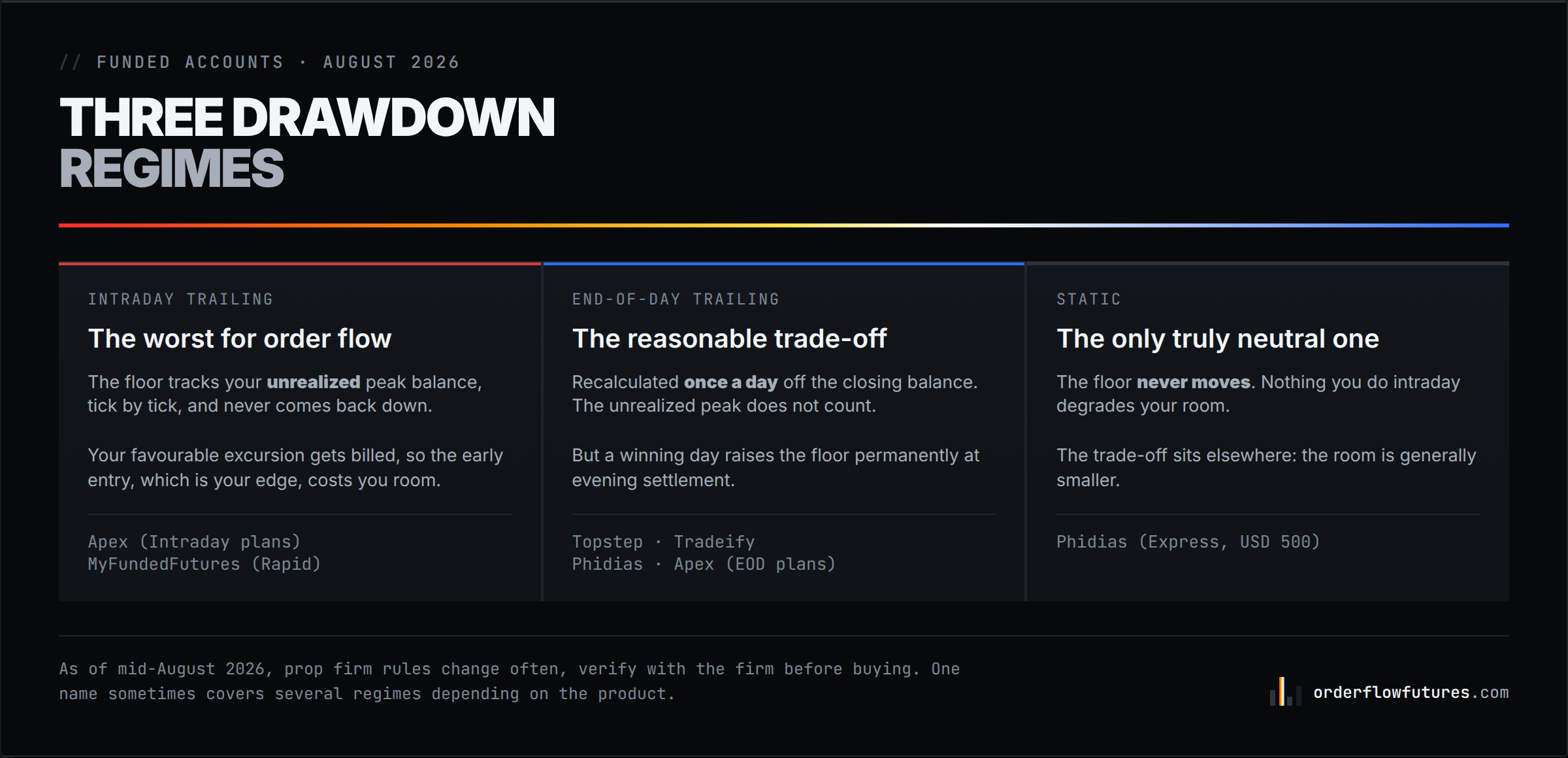
The three drawdown regimes and what each of them actually bills you for.
---
3. Why order flow makes the problem worse
Here is the part that exists nowhere else, and the real reason for this article.
The early entry gets billed
The entire point of order flow is to enter before confirmation. You watch absorption happen, you see the refill, you take the position while the candlestick chart still shows nothing. That is your edge.
Under intraday trailing, that edge turns mechanically against you.
Think in terms of maximum favourable excursion: the best point a trade reaches before you close it. Intraday trailing does not bill your result; it bills your MFE. And for an identical realized result, an early entry always produces a wider MFE than a confirmation entry. You are in sooner, so you capture more excursion on paper, including all the excursion you eventually hand back.
The conclusion is uncomfortable but it is arithmetic: on an intraday trailing account, a confirmation entry costs less room than an order flow entry, for the same banked profit. The rule taxes precisely what you spent months learning.
That is not a reason to abandon the method. It is a reason not to practise it on this type of account, or to adapt it deliberately.
The four order flow reflexes that cost the most
1. Letting it run because the read still holds. "The wall is still there, absorption continues, I'm staying in." Excellent market instinct. Under intraday trailing it is an option you pay full price for: every new unrealized high is deducted from your room, and if the read eventually flips you hand back the money but you keep the floor.
2. Adding on refills. You see the iceberg reload a second time at the same price, you add. Technically defensible. But the unrealized peak is computed on the whole position: adding a third contract multiplies by 1.5 the room cost of every point of excursion you subsequently give back.
3. The classic "take 3 off, let one runner go." A subtle trap, and the most common one. Your unrealized peak was computed while you held four contracts. The runner only gives its excursion back on one. You paid for the floor at 4-lot rates and you are trying to earn it back at 1-lot rates. Structurally losing, in room terms.
4. Holding through an unreadable window. The European midday trough, the US lunch break, the FDAX evening after the Xetra close: thin book, range preserved. A 30-point wick in an empty book raises your floor permanently for a move that carried no information at all.
---
4. Seven concrete vigilance rules
Rule 1: Know your three numbers before your first entry
Not your balance. Three numbers, written somewhere visible:
- your drawdown threshold (the amount);
- your current floor (the balance below which the account closes);
- the peak balance at which trailing locks, if it locks at all.
If you cannot recite those three numbers from memory, you do not know the rules of the game you are playing.
Rule 2: Convert your floor into a price, and draw it
This is the most useful rule in the article, and almost nobody applies it.
Your floor is a dollar amount. Your screen is a price ladder. Until you bridge the two, you are trading blind on the one parameter that can close your account.
The conversion is trivial:
distance in points = remaining room ÷ (number of contracts × point value)
Room of $1,660, 2 NQ at $20 per point: 1,660 ÷ 40 = 41.5 points below your entry. That is your real hard stop. Not the one you chose: the one the firm chose for you.
Now run it with micros and watch what happens: $1,660 on 2 MNQ at $2 per point is 415 points. That is the entire position-sizing debate, settled by one division.
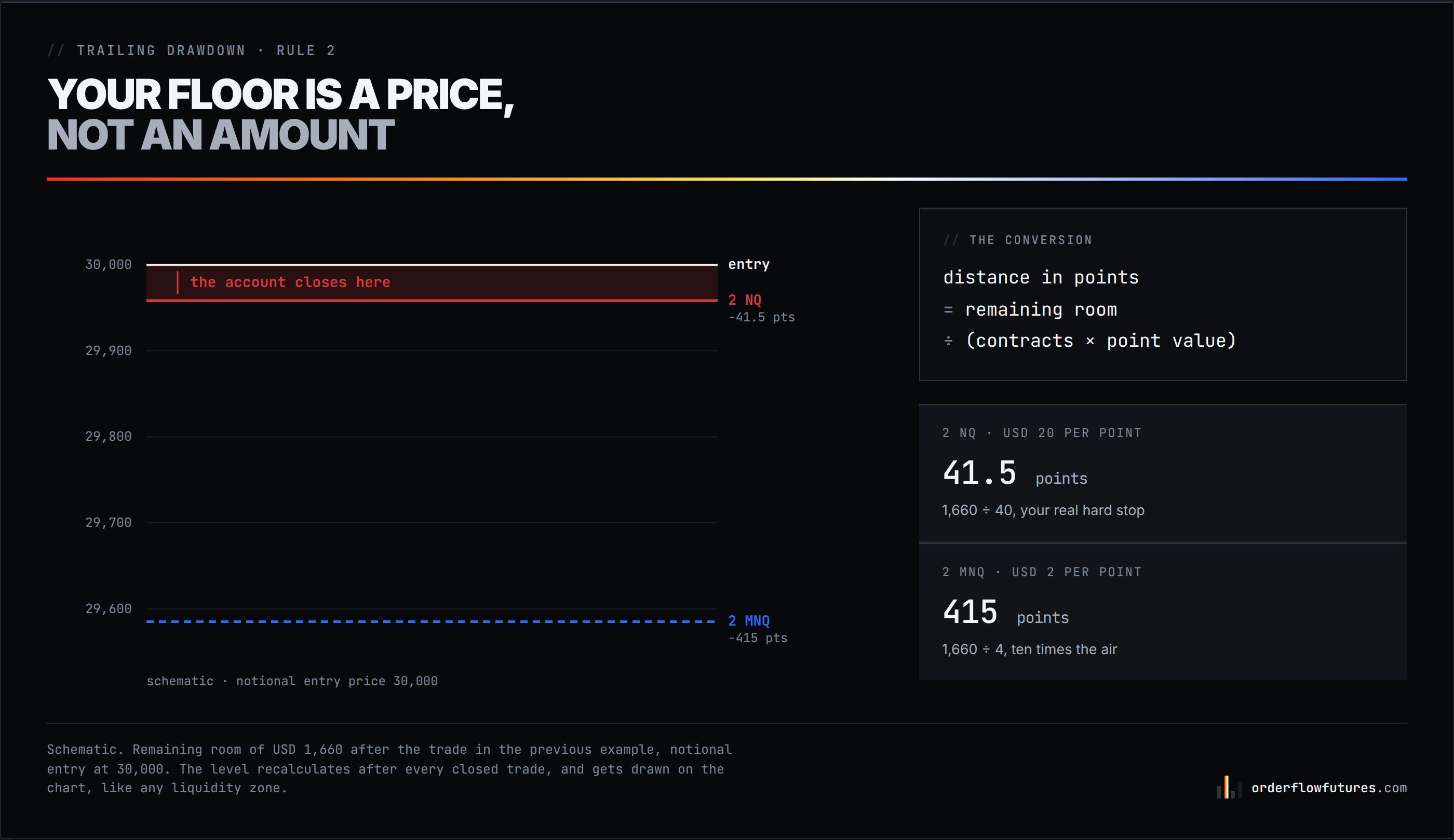
The floor converted into a price: 41.5 points below entry with 2 NQ, 415 points with 2 MNQ.
Draw that level on your chart, alongside your liquidity zones. Recalculate it after every closed trade.
Rule 3: Under intraday trailing, treat MFE as a cost
Concretely: a mechanical partial at the first structural target, no debate, no "the read still holds."
The point is not to clip your winners. It is to convert unrealized, which is billed to you, into realized, which pays you. Under intraday trailing, unrealized profit you fail to convert is a dead loss of room.
Under EOD or static, this rule does not apply. Same method, piloted differently depending on the account.
Rule 4: Get through the trailing tunnel before you loosen up
Since trailing locks at a known level, your account splits into two phases, and they do not play the same way.
Phase 1, the tunnel. Objective: reach the lock point with minimum wasted excursion. Reduced size, mechanical exits, no runners, no adds. This is not the phase where you express your style: it is the phase where you get through a door.
Phase 2, after the lock. The floor is frozen. You can finally let things breathe, hold runners, add on refills. This is where your order flow edge deploys.
Many traders do the exact opposite: they take their biggest risks at the start, while trailing is live, and turn cautious afterwards, when they could finally afford not to be.
Rule 5: Exit on read invalidation, not on stop hit
Order flow gives you a rare privilege: you know before the stop. The refill stops. Delta flips. The limit that was protecting you leaves the book.
On a normal account, waiting for the stop is merely suboptimal. On a trailing account it is doubly expensive: you hand back the excursion AND you keep the floor it made you pay for. The full round trip is the worst-case scenario of the intraday regime.
Make it a written rule: if the reason I entered has disappeared, I exit, regardless of price.
Rule 6: Ban the unreadable windows
List them once and respect the list: the European midday (11:30 to 15:30 on the DAX), the US lunch break, and everything after the underlying cash market closes.
In a thin book, a wick produces MFE without information. Under intraday trailing, you pay floor for noise.
Rule 7: Keep a floor journal, not just a trade journal
Add three columns to your order flow log:
- MFE in points (the best level reached);
- realized in points;
- floor before / floor after.
Then compute MFE ÷ realized across your last twenty trades. That is your trailing tax, and it is the single most useful metric you can track on this kind of account.
Above 2, your exits are not calibrated for this account. Above 4, you are losing the account slowly, with a positive balance, and you will only notice at the end.
---
5. The 2026 landscape: who runs what
State of play as of mid-August 2026. Prop firm rules change constantly: these have moved several times this year. Verify every point on the firm's own site before buying, and treat this list as a starting point, not an authority.
| Firm | Regime | What to know |
|---|---|---|
| Apex | Intraday and EOD depending on plan | Locks at starting balance + $100 on performance accounts; target + $2,000 on Rithmic/Wealthcharts evaluations; never on Tradovate evaluations |
| Topstep | EOD only | You ride the session's ups and downs as long as you finish above the limit |
| MyFundedFutures | Both depending on plan | Standard Rapid = intraday; Rapid EOD (6 August 2026) = EOD + 30% consistency |
| Tradeify | EOD | n/a |
| Phidias | EOD or static, never intraday | Express 25K static at $500; Fundamental and Swing EOD from $2,500 to $4,500 |
Firm by firm:
Apex: intraday trailing on Intraday accounts, computed on unrealized, locking at starting balance + $100 on performance accounts (target + $2,000 on Rithmic/Wealthcharts evaluations, never on Tradovate evaluations). Apex now also offers EOD accounts. Read carefully which product you are buying: the word "Apex" tells you nothing about the regime.
Topstep, EOD only. Their own phrasing captures the spirit: you can ride out the ups and downs of the session as long as you finish the day above the limit.
MyFundedFutures: both, depending on the plan. The standard Rapid runs intraday; a new Rapid EOD launched on 6 August 2026 with end-of-day trailing and a 30% consistency rule (your best day cannot exceed 30% of total evaluation profit: on a $3,000 target that caps your best day at $900).
Tradeify, EOD.
Phidias: EOD or static, never intraday trailing. On the Express 25K the floor is static at $500; on Fundamental and Swing accounts the EOD drawdown runs from $2,500 to $4,500. Structurally, that is the regime most compatible with an order flow method, for the reason set out in section 3: your MFE is not billed.
And one reminder that applies to all of them: do not confuse the daily loss limit with the drawdown. They are two separate guardrails and either can take you out independently. An account can perfectly well pair a comfortable drawdown with a suffocating daily limit.
---
6. The protocol, in three moments
Before the session, two minutes
Write your three numbers. Compute your distance in points for the size you intend to trade. Draw the level on your chart. Decide in advance at what percentage of consumed room you stop for the day: 30% is a reasonable choice; what matters is that it is fixed beforehand and not in the moment.
During the session
After every closed trade, under intraday trailing: recalculate your floor and your distance in points. It takes ten seconds and it is the only way not to discover the problem at the end.
And respect the banned-windows list. It was written cold; you read it hot.
After the session
Fill in the three columns. Once a week, look at the MFE ÷ realized ratio.
If the tax rises while your trading is not deteriorating, it is not your method that needs changing. It is the account. Do not deform an edge that works to fit an administrative rule: pick a rule that lets your edge express itself.
---
The takeaway
Trailing drawdown is not a scam. From the firm's point of view it is a perfectly rational risk mechanism: it stops them funding traders who are living off a lucky peak.
But it is not style-neutral. It specifically penalises those who enter early and let positions breathe, which is to say, precisely, order flow traders. A mechanical scalper who takes 8 points and exits barely feels it. You do.
So make the choice knowingly. If you are attached to your method, take a regime that supports it: EOD or static. If you are already on intraday trailing, apply the seven rules, get through the tunnel with discipline, and stop letting things run before the lock.
And in every case: know your three numbers. The trader who loses an account with a positive balance is always the one who did not.
---
Frequently asked questions
What exactly is trailing drawdown?
It is a loss floor that rises as your account grows and never comes back down. In its intraday form it recalculates off your peak unrealized balance: open profit alone is enough to permanently raise the level at which your account closes. In its EOD form it only recalculates once a day, off the closing balance.
Does trailing drawdown count unrealized profits?
In the intraday version, yes, that is the whole problem. Apex's documentation states it explicitly: the peak balance includes realized and unrealized gains, and the threshold adjusts as soon as an open position pushes the account to a new high. In the EOD version, no: only the closing balance is used.
Can you lose a funded account while being profitable?
Yes, and it is the typical scenario under intraday trailing. On a $50,000 account with a $2,500 threshold, a run of winning trades that each gave back part of their excursion can walk the floor all the way up to your balance without a single realized loss. The account closes with a positive cumulative result.
Does trailing ever stop?
It depends on the product. At Apex it locks at starting balance + $100 on performance accounts and at target + $2,000 on Rithmic/Wealthcharts evaluations, but never on Tradovate evaluations. Knowing that lock point is essential: it splits your account into two phases that should not be traded the same way.
Which drawdown type suits order flow best?
Static, then EOD. The reason is mechanical: order flow gets you in early, so it produces a wide favourable excursion relative to the profit ultimately banked, and intraday trailing bills exactly that excursion. Under EOD or static, your MFE is free. Among the firms named here, Phidias does not run intraday trailing (EOD or static only); Topstep and Tradeify are EOD; Apex and MyFundedFutures offer both regimes depending on the plan.
How do I work out at what price my account closes?
Divide your remaining room by (number of contracts × point value). With $1,660 of room on 2 NQ at $20 per point: 1,660 ÷ 40 = 41.5 points below your entry price. Draw that level on your chart and recalculate it after every closed trade.
Read next
Get the new guides
One email when we publish an OrderFlow or Heatmap guide. No spam, one-click unsubscribe.
By subscribing, you agree to receive our emails. Educational content, not investment advice.