Trading the DAX 40 (FDAX) with order flow: the market almost no prop firm offers
Published · updated · 18 min read
By Tom · Trader & founder of OrderFlowFutures
The FDAX trades in full points at EUR 25 a tick: the book is compressed into nearly five times fewer levels than the NQ, and absorption becomes unambiguous. The real obstacle is not the market, it is access to Eurex depth.
There is a market that most order flow traders will never touch. Not because it is bad. Because the data is expensive, because platforms stop at the CME, and because nobody bothers to explain why.
That market is the DAX 40: the FDAX contract on Eurex. And if you already read the Nasdaq through order flow, you are about to meet an order book that behaves in a fundamentally different way.
The FDAX is the futures contract on the DAX 40 index, listed on Eurex in Frankfurt. One index point is worth EUR 25, and the minimum tick is that full point, where the Nasdaq trades in quarter-points: a price step four times wider, and five times more expensive. The direct consequence for order flow: the book is compressed into fewer levels, each one carries more size, and absorption becomes far easier to read. The obstacle is not the market. It is access to order-by-order depth.
---
1. The FDAX is not "a European Nasdaq"
This is the first mistake, and it is an expensive one: showing up on the DAX with your NQ settings.
The numbers that change everything
| Contract | Point value | Minimum tick | Tick value |
|---|---|---|---|
| FDAX | EUR 25 | 1 full point | EUR 25 |
| Mini-DAX (FDXM) | EUR 5 | 1 point | EUR 5 |
| Micro-DAX (FDXS) | EUR 1 | 1 point | EUR 1 |
| E-mini Nasdaq (NQ) | USD 20 | 0.25 point | USD 5 |
Sit with that last line for a second. On the NQ you get four price steps per index point. On the FDAX you get one. Your DOM ladder is not the same object anymore.
The notional trap
People instinctively assume the DAX is "bigger." It isn't, or rather, it isn't where it matters.
In mid-August 2026, with the DAX around 26,350 points and the Nasdaq-100 at 30,046 points:
- One FDAX carries roughly EUR 658,750 of notional.
- One NQ carries roughly USD 600,920 of notional.
In other words: the two contracts weigh about the same. What differs is not contract size, it is how finely the market is sliced. Relative to each index level, the same economic volume spreads across nearly five times fewer price levels.
Which brings us to the single most useful fact in this article: twenty book levels cover 20 DAX points, versus 5 Nasdaq points. Against daily ranges of a broadly comparable order of magnitude on both sides, the FDAX's visible depth spans a much wider slice of the market. You see further into the book.
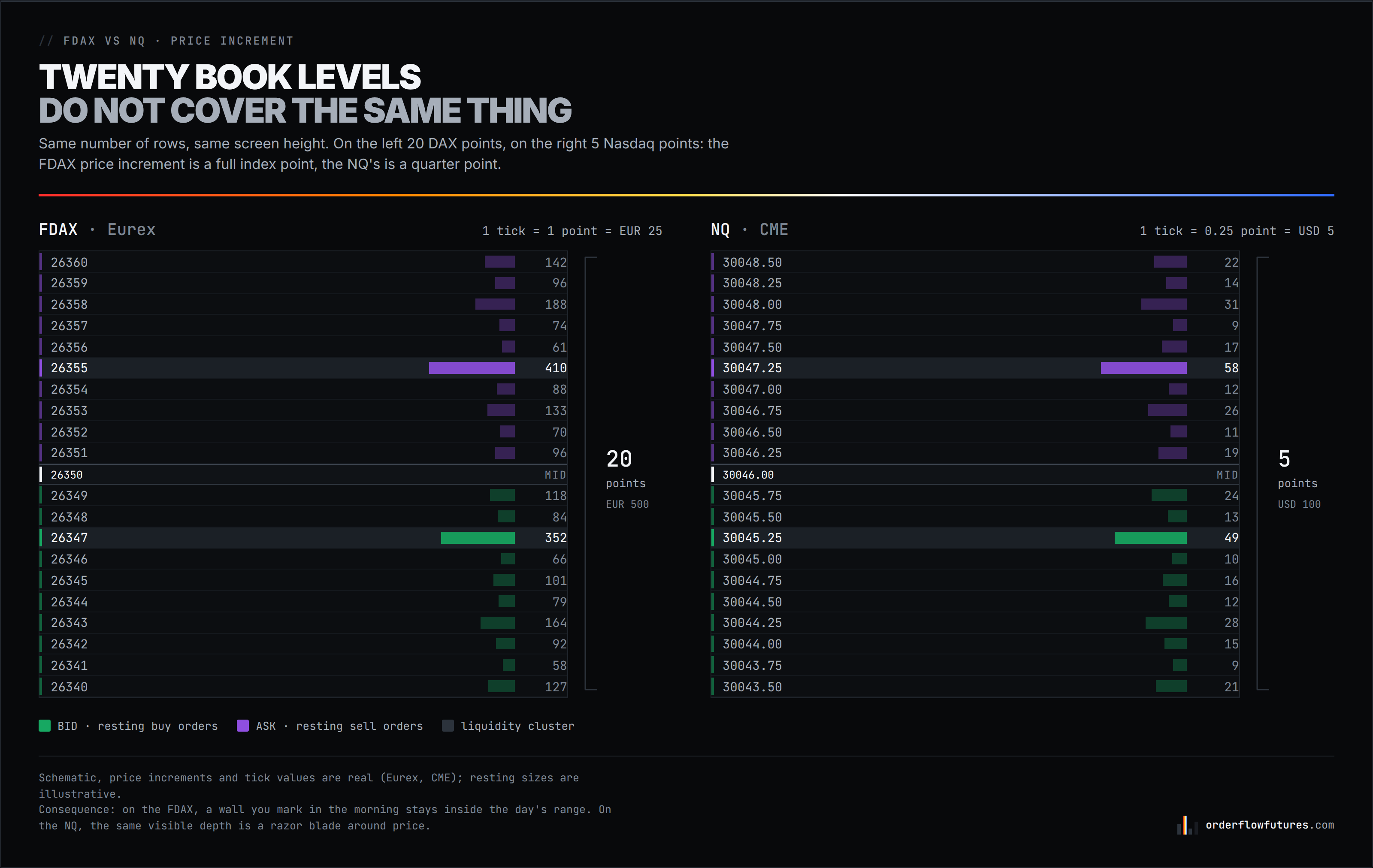
Same number of rows, same screen height: 20 FDAX levels cover 20 index points, 20 NQ levels cover 5.
The Micro-DAX is smaller than the MNQ
Counterintuitive, and very good news if you are starting out:
- FDXS (Micro-DAX) ≈ EUR 26,350 notional, EUR 1 per tick.
- MNQ (Micro Nasdaq) ≈ USD 60,092 notional, USD 0.50 per tick.
The Micro-DAX is a contract roughly half the size of the Micro Nasdaq. If you want to learn to read a Eurex book with negligible risk, the FDXS is probably the smallest serious major-index contract available to you.
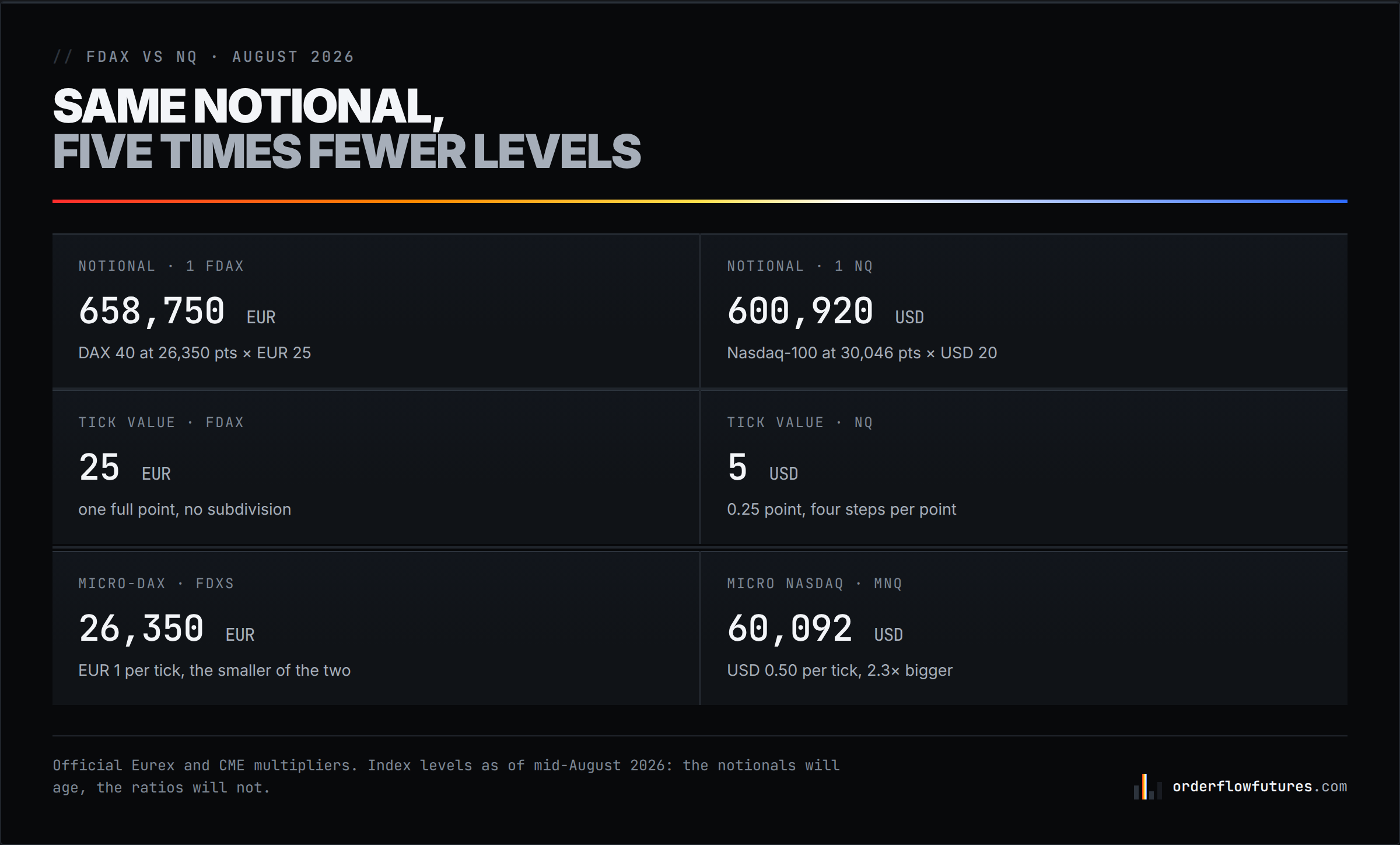
Both contracts carry comparable notional: what differs is how finely the market is sliced.
The clock: two markets inside one day
The FDAX trades continuously from 02:10 to 22:00 Frankfurt time, with pre-trading from 02:00 and post-trading until 22:25. But those hours are not what matters. What matters is the German cash market behind it:
- 09:00, Xetra opening auction. The first genuine price discovery of the day.
- 09:00 → 17:30, continuous trading in DAX constituents.
- 13:00, Xetra intraday auction.
- 17:30, closing auction.
- 15:30, US cash opens. The DAX stops writing its own story.
The NQ essentially has one regime: US cash from 15:30 to 22:00 CET, with an overnight session that is little more than a waiting room. The FDAX has three: an endogenous European morning, an afternoon imported from the United States, and an evening with no underlying cash market at all.
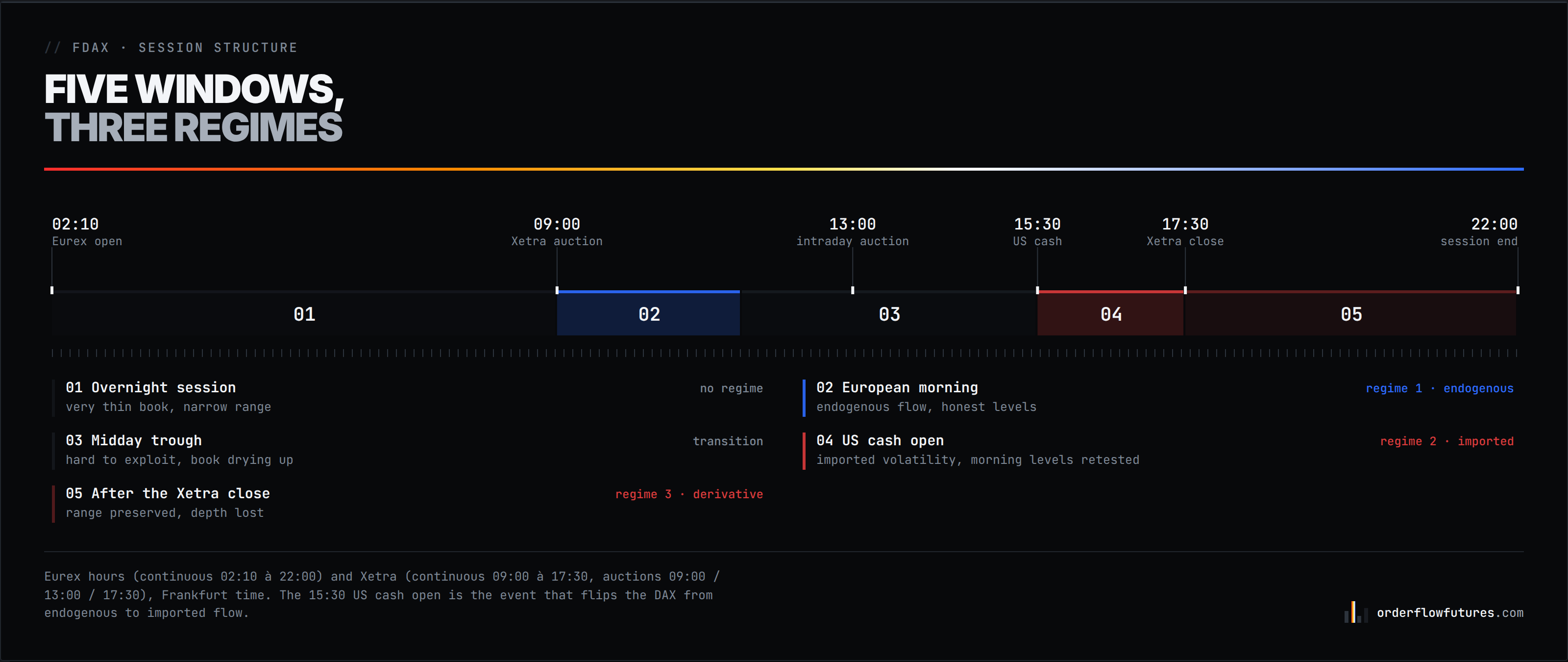
The five windows of the FDAX session and the three flow regimes they trace.
A detail that gives away the regulars
The DAX is historically a performance index: dividends are reinvested. The concrete consequence, which you will never see on the Nasdaq-100, is that the index does not drop mechanically on ex-dividend days. The relationship between the future and the cash does not jump for a purely technical reason. One less source of noise in your basis reading.
---
2. What that actually changes in the book and the footprint
Here is the part nobody writes. We move from specifications to what you see on screen.
The DOM is compressed, and that is a gift
On the NQ, a stack of 40 visible levels covers 10 index points. That is a razor blade around price. Large participants can spread their intent across dozens of 0.25-point steps, and much of what you see moves faster than your ability to interpret it.
On the FDAX, those same 40 levels cover 40 points. The visible book spans a real portion of the trading day. The wall you identify at 11:00 is not an artefact three ticks from price: it is a level the market will actually have to go through.
Operational translation: on the DAX, liquidity levels hold across the session. You can mark them in the morning and find them again in the afternoon. On the NQ, a large share of the book's structure is permanently rebuilding itself.
Absorption becomes unambiguous
This is the most striking difference when you switch.
Absorption is aggressive market flow hitting a resting limit that refuses to move. On the NQ, the participant accumulating can hide: they slide 0.25 at a time, reappear a step lower, dilute their footprint across fifteen levels. You see something, but you are never certain it is the same actor.
On the FDAX, they no longer have enough price levels to hide in. If they want to absorb 800 lots, they absorb them across one, two, three prices at most. A refill at the same price becomes an unambiguous event, which is exactly what an iceberg detector is built to catch. On the DAX, when the Iceberg Detector lights up, there is genuinely someone behind it.
In my view that is the strongest reason to look at this market once you are already comfortable with order flow: absorption signals are less frequent but considerably more reliable.
The footprint is dense, and needs recalibrating
Same economic volume, five times fewer price cells. Your DAX footprint cells therefore contain much larger numbers, and diagonal imbalances trigger far less often.
Two adjustments to make immediately:
- Raise your imbalance thresholds. A 3:1 ratio calibrated on the NQ will fire constantly on the DAX.
- Switch to volume or range bars instead of time bars. The DAX alternates between stretches where nothing happens (11:00 to 13:00) and minutes where everything does (15:30). A 5-minute candle does not contain the same thing depending on the hour: far less so than on the NQ, where flow is more evenly distributed.
Delta and CVD follow the same logic: fewer transactions, larger clips, therefore rarer and more meaningful divergences. You wait less often, but what you are waiting for is worth something.
Crossing the spread costs EUR 25, change how you enter
This is the price you pay for everything above.
Crossing the spread on one FDAX costs EUR 25. On one NQ it costs USD 5. Two market-order round trips in a mediocre session and you have consumed a meaningful share of what you hoped to make.
Three consequences I consider non-negotiable on this market:
- You enter on the limit. Market orders on the FDAX are for exits and emergencies.
- You do not "test" an idea with a full-size contract. The FDXM and FDXS exist precisely for that.
- Your stops are sized in points, never in ticks. An "8-tick stop" as you would use on the NQ means 8 DAX points, i.e. EUR 200 on a full contract. That is not a tight stop; that is a stop with no relationship to structure.
Auctions are real liquidity events
This is a European feature with no intraday equivalent on the Nasdaq.
The 09:00 opening auction concentrates a considerable volume in a single instant and sets a reference price that shapes the morning. The 13:00 intraday auction breaks the lunchtime torpor. The 17:30 auction closes the cash market while the future keeps trading.
Practically: the opening auction price is a level worth marking. It is one of the few reference points in the day that you know a very large number of institutional participants have in their systems. On the NQ, the 15:30 opening cross plays a comparable role, but there is no equivalent of the 13:00 auction.
15:30: when the DAX stops speaking German
If you take away one behavioural fact from this article, make it this one.
Between 09:00 and 15:30, the DAX is built from its own flow: European data releases, arbitrage on constituents, positioning from local desks. The book is thinner, but honest: the levels that form do so for endogenous reasons.
At 15:30, US cash opens and the DAX becomes, to a large extent, a derivative of the S&P and the Nasdaq. The European book gets driven through by flow that has nothing to do with it.
The order flow read this produces is powerful, and specific to the DAX: a level built in the morning is retested in the afternoon under completely different conditions. If the same limit size reappears at 15:45 on the price where you saw absorption at 11:00, you are looking at a participant with a genuine mandate at that price. If it evaporates, it was European-session liquidity, and it will not protect you.
The NQ does not hand you that natural test. The DAX gives it to you every day.
The reverse holds too: after 17:30, be careful. Cash is closed, the book thins out, but the future is still being pulled by the United States until 22:00. Range preserved, depth lost, EUR 25 per tick: the worst risk-to-readability ratio of the day. Beginners on the DAX get taken apart between 18:00 and 20:00 almost without exception.
---
3. The real obstacle: Eurex data
Now the honest question. If the FDAX is so readable, why does almost nobody trade it with order flow?
Because depth costs money, and most players stop before paying for it.
EOBI: Eurex broadcasts order-by-order natively
Eurex publishes its book through T7 EOBI (Enhanced Order Book Interface), a market-by-order feed: it transmits order-by-order updates of the full book, not an aggregation by price level. That is precisely the raw material a serious liquidity heatmap needs.
Not to be confused with the other T7 feed, EMDI, which is market-by-price: aggregated depth, limited number of levels. That is what most brokers call "Level 2."
The difference is not cosmetic. With aggregated MBP you see "340 lots at 26,350." With MBO you see how many orders make up those 340 lots, and, crucially, you see that a 200-lot order was just cancelled and immediately replaced. Icebergs, pulls and refills are invisible in aggregate. Without MBO, a Eurex heatmap is not a heatmap: it is a colour gradient painted over numbers that have already been summarised.
What it actually costs
Here are the orders of magnitude as of summer 2026 (re-check before you pay, these grids move):
- DeepCharts licence: Orderflow USD 59/month, Full Advanced USD 79/month, Pro USD 125/month. With the current discount, roughly USD 50, 67 and 94 respectively. DeepDom alone (the heatmap and book tools) is USD 33/month.
- Data feeds: dxFeed from USD 19/month, Rithmic from USD 57/month.
- CME MBO depth, USD 39/month.
- Eurex MBO depth: +USD 65/month, on top.
A complete, readable Eurex setup therefore costs around USD 134/month direct: Orderflow licence + dxFeed + Eurex MBO depth.
For comparison: Apex, which offers the Micro-DAX, requires roughly USD 23/month for a Eurex Level 2 subscription. Three times cheaper, because it is not the same data. Aggregated Level 2 lets you place orders. It does not let you do order flow.
That is the whole explanation for this market's scarcity: USD 65 a month is a cost line that neither retail brokers nor most prop firms want to carry for a contract 2% of their clients look at. It is not a conspiracy, it is economics.
It is also what leaves room.
---
4. The prop firm landscape: who actually offers the DAX
Here is the state of play as I read it in summer 2026. Prop firm conditions change fast: verify every point directly with them before buying an account.
Phidias: the full DAX ladder (FDAX, FDXM, FDXS) plus the rest of Eurex: Euro Stoxx 50, Micro Euro Stoxx, Euro-Bund, Euro-Bobl. Platform: DeepCharts, included with the account at no extra cost. Currently the broadest European lineup, and the only one pairing Eurex access with a native order flow platform.
Tradeify: FDAX, FDXM, FDXS, plus Euro Stoxx 50 and the German bund complex. Platform: Tradovate. Broad market access, but the order flow tooling is not at the same level.
Apex: Micro-DAX only (FDXS). Neither the full contract nor the mini. Platform: Tradovate, with a Eurex Level 2 subscription at around USD 23/month on you.
Topstep, no Eurex. CME only. It has been announced for years and has never arrived.
One thing to check carefully with any firm: market access is not depth access. A prop firm can perfectly well let you trade the FDAX while serving you aggregated Level 2. Ask explicitly before paying: "is Eurex order-by-order depth included, or do I subscribe separately?" The answer determines whether you will be doing order flow or clicking on a price ladder.
Another practical point, often forgotten: the FDAX settles in euros. If your funded account is denominated in dollars, you add a conversion at every payout. Not a dealbreaker, but worth knowing in advance.
Managing risk once funded
The EUR 25 tick demands a discipline the NQ still partly forgives. Three rules that are not negotiable on this market:
- Size by drawdown, not by margin. On an evaluation with EUR 2,500 of drawdown, a 20-point stop on one full FDAX is EUR 500: a fifth of your entire error budget, on a single trade. The FDXM, and the FDXS even more so, exist precisely for this.
- Stay flat ahead of European data. German CPI or an ECB decision cuts through 40 points in seconds, in a book that emptied out just before. That is not order flow, it is a lottery.
- Avoid intraday trailing on this contract. The combination of a big tick, DAX volatility and a floor that tracks your unrealized peak is the most punitive there is: I walk through the mechanism in the number one trap in funded accounts. Prefer an end-of-day or static drawdown.
---
5. Where to start: a 30-day plan
No shortcuts. Here is what I would do in your position, in this order.
Week 1, Watch without trading
Set up the heatmap and footprint on the FDXS, with Eurex MBO depth active. Place no orders.
Every day, note three things and nothing else:
- the 09:00 opening auction price;
- the high and low of the 02:10 to 09:00 window (the DAX "night," usually narrow);
- where the two largest liquidity clusters sit on the heatmap at 10:00.
At the end of the week, count how often the market went looking for those levels in the afternoon. You will be surprised.
Week 2: Recalibrate your settings
Take your NQ thresholds and raise them. Concretely: increase your footprint imbalance ratio until you only get a handful of triggers per hour, and switch your candles from time to volume.
Then do the replay exercise: replay three sessions and look for refills at the same price only. Not entries, not targets. Just: "at what price did someone put size back after being eaten?" That single habit is the one that transfers from the NQ to the DAX and gets better in the process.
Week 3: Trade the 09:00 to 11:30 window, and nothing else
One FDXS contract. European morning only. You forbid yourself 11:30 to 15:30 (the trough) and everything after 17:30 (the ghost book).
The goal is not the result. The goal is to verify that you can enter on the limit, at a level you had marked before price got there.
Week 4, Add the 15:30 test
Keep the morning routine. Add exactly one thing: at 15:30, revisit the levels where you spotted absorption in the morning and watch whether the size comes back.
That is the core of the DAX-specific edge. Once you can do it reproducibly, you can consider the FDXM, then the full contract.
What you need for any of this to work
Be clear-eyed about the prerequisites. There are three, and none is optional:
- A platform that reads EOBI order-by-order. This is the hard part. Few retail tools expose Eurex depth in MBO; DeepCharts is the one we work on and the one whose settings we document here.
- The Eurex depth subscription. The USD 65/month. There is no credible free version of this data, and a delayed feed is useless for order flow.
- A contract small enough to survive your learning curve. The FDXS. At EUR 1 per tick, you can be wrong a hundred times and still be in the game.
On the first point, two routes. Direct: DeepCharts licence + feed + depth, around USD 134/month, you stay independent, you keep your configuration whatever happens, and the code OFF applies the launch discount. Through a prop firm: at Phidias, DeepCharts comes with the account, which removes the licence line from your budget, just confirm with them whether Eurex depth is included as well.
The full pricing breakdown, feed by feed, is on our DeepCharts page; the market context is on Eurex.
---
My honest take
The DAX is not a "better" market than the Nasdaq. It is slower, more expensive per tick, and it demands an entry discipline the NQ still partly forgives.
But if what you want is a book where absorption is visible to the naked eye, where levels hold across the session, and where you are not competing with ten thousand scalpers over the same 0.25 point, then yes, it is worth the detour. The FDAX is one of the few major markets where the barrier to entry is a data cost, not a skill. Data costs can be paid. Skills cannot.
And to be complete about what that implies: this is a market with very little educational content, very few prop firms, and therefore very few people on the other side. Make of that what you will.
---
Frequently asked questions
Is the FDAX suitable for someone new to order flow?
Not in full size: at EUR 25 per tick, learning gets ruinous fast. The Micro-DAX (FDXS), however, at EUR 1 per tick and roughly EUR 26,000 of notional, is smaller than the Micro Nasdaq (MNQ). It is an excellent learning contract, provided you have order-by-order depth.
What is the difference between Eurex Level 2 and MBO depth?
Level 2 (the EMDI feed) gives aggregated depth per price level: "340 lots at 26,350." MBO (the EOBI feed) gives the book order by order: how many orders make up those 340 lots, which one was just cancelled, which one was refilled. Icebergs, pulls and refills are invisible in aggregate, so a heatmap fed with Level 2 carries no real informational value.
Which prop firms allow DAX trading in 2026?
Phidias (full FDAX/FDXM/FDXS range plus the rest of Eurex, with DeepCharts included), Tradeify (full DAX range on Tradovate) and Apex (Micro-DAX only). Topstep remains CME-only. Always check whether Eurex MBO depth is included or has to be subscribed separately.
What time of day should you trade the FDAX?
The most readable window is the European morning, between the 09:00 Xetra opening auction and 11:30. The midday trough (11:30 to 15:30) is hard to exploit. The US cash open at 15:30 brings imported volatility that retests the morning's levels. After the 17:30 Xetra close, the book thins out while the range persists: the worst risk-to-readability ratio of the day.
How much does a Eurex order flow setup cost?
Budget around USD 134/month direct as of summer 2026: platform licence (from about USD 50 with the discount), data feed (dxFeed from USD 19) and the Eurex MBO depth subscription (+USD 65). Going through a prop firm that includes the platform, such as Phidias, removes the licence line. These grids change: verify before subscribing.
Does the DAX move more than the Nasdaq?
The two contracts carry comparable notional: around EUR 659,000 for one FDAX versus around USD 601,000 for one NQ in mid-August 2026. The difference is not the size of the risk per contract but the granularity: the DAX tick is worth five times the Nasdaq tick, which compresses the book into fewer levels and makes every tick of slippage far more expensive.
Read next
Get the new guides
One email when we publish an OrderFlow or Heatmap guide. No spam, one-click unsubscribe.
By subscribing, you agree to receive our emails. Educational content, not investment advice.